
Thirty years earlier or thirty years later, freedom corrects - always.
A manifesto marking the 30th anniversary of Napoli Pride, arguing that LGBT lives, identities, desires, and families are not errors to be “corrected,” while calling for visibility, human dignity, political responsibility, and ethical leadership within Pride organisations and LGBT associations themselves.
Estimated reading time: 23-25 min
21 June 2026
Freedom cannot be corrected. And how could it be? It is the very essence of life. It is emancipation by thought, expressed through freedom of expression, freedom of worship, freedom of publication, and more.
We human beings are born free, responsible for our freedom, and it is this freedom that ensures the continuity of our species in the face of hardship, disaster, and tragedy.
Freedom cannot be corrected; it is itself a correction.
Correction of our subjugation to an idea, to a way of thinking, to an ideology.
Subjugation to collective behaviour. Through conformity. Through fear of a certain kind of social exclusion.
And so what?
And then, what is a correction?
Is it the correction of a body, itself conceived in divine perfection?
Is it the correction of an identity, itself heir to the complexity of a family lineage, with all the social and identity-based attributes produced by marriages, relationships, and environments?
Orientations, desires, affections, and families cannot be corrected.
They invite us to understand, through the lens of respect and in dignity; not through demonstrative intellectualisation.
We understand in order to reflect, discuss, learn, and marvel at the immensity of creation.
Disagreement - dissent - cannot be corrected. It is part of the debate of ideas, which produces further ideas: a gymnastics of the mind, of intellect, and of intuition.
The freedom to exist, to self-determine, and to live one’s life fully cannot be corrected. It is a search for truth, and it is only through truth that we live authentically, experience ourselves as authentic, live with others authentically, and encounter others with authenticity.
While we readily denounce the authoritarian, repressive, and moralising drift of a political era in which everything that does not conform is targeted, delegitimised, and marginalised, we must remember that the “political era” is only the expression of society in the political sphere. In other words, an authoritarian, repressive, and moralising political era is also (the reflection of) an authoritarian, repressive, and moralising social era. And we, LGBT people, are part of that society. We remember then that we criticise what we ourselves are guilty of. We, LGBT people, have often displayed authoritarianism in the way we treat other LGBT people, repressing opinions that did not resonate with our own, moralising, behaving as moralists, climbing onto our high horses in the name of a supposed moral superiority and an ostentatious signaling of virtue. A virtue we seek, often without finding it.
A society that does not understand that difference, particularity, singularity, distinction, is nothing other than the synthesis of each individual in their human integrity is a society flirting with totalitarianism. It is a society in which the individual is no longer whole, no longer considered a complete human being, but merely a constituent part of a group: an inert and depersonalised mass in which each person’s capacity to act disappears and individual responsibility dissolves. From that point on, every abuse, every trap, and every form of blackmail becomes possible, because no one is any longer truly held accountable for themselves.
Seen from above, “difference” is not an anomaly to be contained: it is the force that pushes back the perimeter, the borders, the edges, and the walls of the flattening of humanity into the mould of ease called normality.
Seen from above, “subjectivity” is not a problem to be disciplined: it is the breath of each person, the contribution a person makes to themselves and to others, so that, together, we may form a society.
Seen from above, “freedom” is not a concession to be limited: it is the very attribute of existence, unfolding beyond the heavens, through creativity and innovation; it is divinity.
To say that some lives are mistakes that should be remedied, that some existences are deviations to be corrected, is to call for and exhort death, destruction, and needless suffering. It is to surrender to the perversion of the mind; to vicious practices shaped by moralising ideas of violence, degradation, and the annihilation of dignity: humiliating, inhuman, and cruel treatment capable of causing severe suffering as well as permanent psychological and physical harm. It is the cult of evil, quite simply.
* * * * *
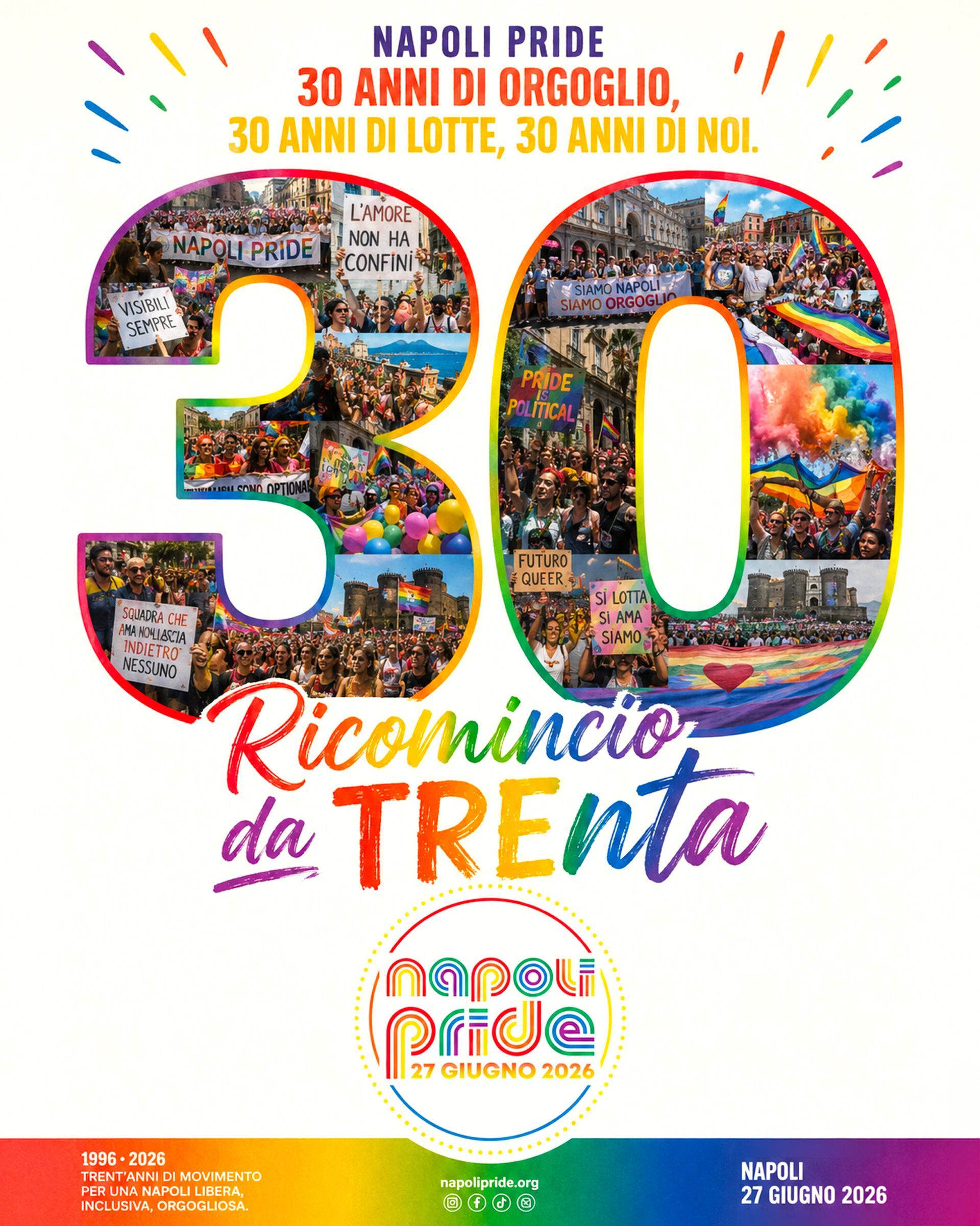
As Naples Pride 2026 states in its political manifesto marking thirty years of existence, Pride is a political and social seismograph, capable of anticipating its time and, consequently, of informing the national agenda. It is collective and emotional work that moves across generations, people, struggles, social transformations, and memory; it is a thirst for the future. It is therefore, inevitably, a tribute to life, extending into territories, subjects, and themes that many fear exploring. And with good reason.
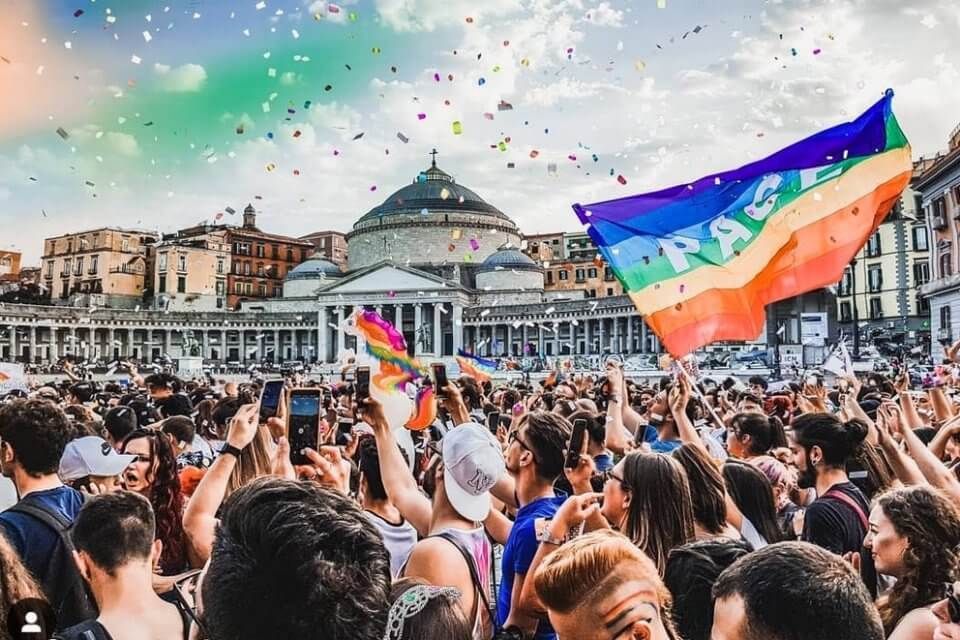
Pride organises the visibility of LGBT realities in public space, because it is only through visibility that we can deconstruct the myths, lies, and prejudices surrounding LGBT realities. LGBT people are a cross-section of society as a whole and, in this sense, Pride holds a magnifying glass up to society itself. What we see there resonates at local, regional, national, continental, and far broader levels, because the human condition is universal.
For this reason, Pride is a living practice of democratic participation in pursuit of and in service of social justice - a justice that belongs to an ongoing process rather than to an objective definitively attained, because life is fluid, and so are its expressions.
Naples is a city of the sea, a port, and a place of welcome. Since 2013, Naples’s Pride march has carried the name
Mediterranean Pride of Naples. The Mediterranean is not merely a sea: it is a fluid crossroads of cultures, languages, bodies, and stories, which meet and mingle without ever neutralising one another, without ever cancelling one another out.
Mediterranean Beirut tells a similar story: that of a city that carried the Arab renaissance, publishing, and the sharing of knowledge; that of a refuge in the face of the autocratic regimes of the region and the Arab-speaking world, a home for those who sell, who lose, who leave - sometimes even to the extreme. Yet extremes are dangerous: exaggeration and irresponsibility fuel conflicts and (civil) wars, and Beirut can testify to that.
Naples is one of the capitals of this intersection: a land that has historically welcomed differences and made them its own, rejecting the very idea of borders and exclusion. In a city of peace that has made hospitality one of its deepest traits, the message resonates with particular force: whoever welcomes you receives you for who you are. In our sea as in our cities, freedom circulates, bodies meet, and life, quite simply, cannot be corrected.
At Pride, one is never merely a spectator: we shape it through our presence, our absence, and our participation, which I dare hope is effective, informed, and enlightened. After all, every individual bears responsibility for their own life: the responsibility to raise their voice, to speak, to say what they want, and to say what they do not want.
Otherwise, others will do it in our place. And often clumsily, deceitfully.
Politics is the management of life in the city so that cohesion, coexistence, prosperity, and stability may prevail. It must cease to be persecution and propaganda, fear and punishment - both in its acts and in its words.
For example, it is not a question of “tolerating” the other, but of respecting, recognising, and protecting individuals from the hazards of violence. And for this, the solution is simple: it is already rooted in culture, education, and legislation. Yet we drag our feet when it comes to applying it.
The security of countries is certainly non-negotiable, and it does not need to lock itself into exclusion, alarmism, or panic. Of course, and let us acknowledge it, Europe stands at the threshold of a violent regression. But social difference is the strength of a society: it absorbs shocks and creates cohesion. It would be counterproductive to regard difference as a target to be destroyed, as a scapegoat on which to place the problems of our time, or as a distraction intended to divert citizens’ attention from the real problems, failures, and challenges.
Political and electoral calculations should neither evade these issues, nor instrumentalise them, nor turn them into chaos. Access to healthcare, employment, and safe housing, protected from abuse and coercion, must be discussed in light of the realities specific to each territory. These measures must aim to promote the individual’s autonomy and social inclusion. The exclusion of people from these rights therefore cannot prevail, especially in the case of vulnerable people or those rejected by their families, trans and non-binary people, people with migrant backgrounds, racialised people, sex workers, and people with disabilities. This exclusion is a time bomb. Political leaders must address it and provide answers, in a spirit of lasting and continuous social responsibility.
We all know that transphobia, transmisogyny, and enbyphobia kill; that they can drive trans and non-binary people to suicide after making their lives impossible. Regardless of our understanding, our experiences, or our proximity to these people and their realities, we know that nothing takes precedence over human dignity. It is up to us to speak, rather than hide behind a general silence that is complicit through inertia. This concerns every sphere: families, the media, schools, the healthcare system (including hospitals, ordinary medical treatment, and those who administer it), prisons, and other sites of social life.
But the most critical issue is generational and begins with children, whose protection depends first and foremost on the protection of families. In this sense, minors cannot be abandoned because of a lack of adoption policies or ambiguity regarding the responsibilities of adults towards minors that arise from adoption. We cannot compromise children’s emotional and affective continuity, safety, and stability in the name of ideologies rooted in panic and fear. The law exists to support individuals and provide them with concrete solutions. Restrictive laws only prolong insecurity and fear: they alienate lives, create anger, encourage abuse, and then end up being repealed themselves. Why cause so much unhappiness? Why prolong suffering?
* * * * *
The greatest challenge that we, LGBT people, face is internal. We cannot address it without dismantling the shame we carry and lying that we have learned to master with such ease. Whether it takes the form of leading a double life or living by a double standard, once lying becomes a natural reflex, truth ceases to be sought. We then become prisoners of our own lies.
This is why the challenges ahead of us are immense and, above all, internal, everywhere in the world. Many of these challenges will be used in an attempt to confirm the stereotypes that some people already hold about LGBT people. In this context, let us not place the blame on others. This is not a reality manufactured by a political figure: it is also ours, and we must confront it. Everywhere, many people who have worked within LGBT associations or Pride organisations have adopted financial, bodily, sexual, or manipulative behaviours. The real victims always end up speaking. It is only a matter of time, and we must be ready, when the time comes, to accept the consequences of acts committed “in our name.” This begins with the courage to look at ourselves in the mirror, to accept our shortcomings, to undertake institutional reform, to establish and enforce clear policies, and never to cover for those whose actions have caused harm - neither out of friendship, intimacy, nor personal loyalty. We can only succeed by honouring the dignity of each person, including that of those who have committed such wrongs. It is not necessary to humiliate or hand someone over to public vindictiveness in order to affirm a position or publicly demonstrate that one is distancing oneself. Nor is it necessary to resort to gossip, lies, misinformation, or disinformation. It is up to us to honour the truth, however difficult it may be, because only the truth sets us free.
To Pride organisations and LGBT associations:
Pride organisers and LGBT associations exist to make LGBT issues visible. Visibility is essential to deconstruct the myths, lies, and prejudices surrounding LGBT realities, in order to ensure that our dignity is respected. This is the first mission of those who work on these issues. Everything else is secondary. Everything else.
While Pride organisers and LGBT associations repeat that LGBT rights are under attack, many devote a considerable part of their energy to subjects far removed from their primary mandate. Why should an entire LGBT ecosystem not concentrate 100% of its action on LGBT realities in its immediate environment, consolidating its achievements and honouring its commitments? What is the effectiveness, what is the sustainability, of activism founded on alarmism and fatalism? In this regard, a question arises: do Pride organisers and LGBT associations genuinely serve LGBT people, or do they use LGBT people as cover to pursue other causes in which they wish to engage? Before answering with ready-made phrases such as “LGBT people are historically connected to resistance” or “LGBT people fight oppression,” let us remember one simple thing: resisting and fighting oppression are not attributes exclusive to LGBT people. They are attributes inherent to human beings.
Groups that succeed, that is to say, those that achieve the objectives they set for themselves, organise around precise mandates and clearly defined goals. By contrast, slogans lack precision and do not translate into concrete change. Likewise, the excessive broadening of a field of action rarely produces genuine impact. On the contrary, it turns public and social action into a disappointing, frustrating, bitter, manipulative, and ultimately unfinished promise of change and liberation. Such a drift distances people from the hope of better days. To that loss is added a considerable waste of time, material resources, and intellectual capacity that could have been invested in real transformations. It is therefore essential that Pride organisers and LGBT associations immediately take responsibility for this way of operating and remedy it. Failing that, they will be the first responsible for the collapse of public trust in LGBT organisation and action. And when that happens, the blame should not be placed on supposed “radical LGBT people” or on some “crazy politicians.”
Leading in public space is a delicate task. When it is neither sufficiently informed nor adequately equipped, it produces costly mistakes, whose first victims are often the most vulnerable among us. Pride organisers and LGBT associations have a responsibility to train continuously, beyond the boundaries of ideology and the principles one proclaims to oneself. We must approach LGBT realities, social and political issues, and field practices with an open mind: first in our own territories and jurisdictions, then internationally, so that we may build upon the experiences of others. Knowledge strengthens us; it gives us clarity and direction. It also enables us to swim against the current when necessary, even when doing so is unpopular. Pride organisers and LGBT association leaders cannot content themselves with repeating or adopting postures and positions based on information gathered and cross-checked on social media, even when it reassures them or gives them the feeling of being on the right side. Intellectual shortcuts and simplifications miss nuance and ignore the complexity of the real world, the world in which concrete work is done. Knowledge and precision matter enormously. In any case, no Pride organiser or LGBT association leader can present themselves as a victim of their own role: after all, we are executive leaders. Either we know what we are doing, or we bend to the loudest voices. In any case, there is no Pride without clarity, direction, courage, and dignity.
The many Pride organisers and LGBT association leaders - even more numerous still - who seek to reinvent themselves, to recycle themselves around new subjects, must first and foremost take stock of their existing public and social action. They must document the processes they have followed, for posterity, for collective learning, and in the interests of integrity and mobilisation. Before venturing into areas beyond their borders, particularly sensitive subjects linked to religion, race, politics, or other complex realities, each person should first familiarise themselves with issues closer to home, in their own context. Unfortunately, many address only those who are already convinced, adopting a dishonest performative posture. In doing so, they obstruct the dignity of those they claim to support. and end up instrumentalising them for personal visibility, selfish social recognition, or calculated attention. The postures of outsiders, as well as the attitude of “I know better” that claims to tell the world what is right and what should be done in other people’s territories, remind us that “anti-colonial” chants are nothing but empty slogans, and that the principle of self-determination so often proclaimed is never truly respected.
LGBT people who have access and intellectual resources must become involved in Pride organisations and LGBT associations. They can help focus on local realities before looking outward, defend the positive work already achieved, better guide future actions, and support LGBT people who need help. Solidarity is not subject to invented hierarchies of suffering, and we do not free ourselves by creating new oppressed people.
In conclusion, every Pride is someone’s first Pride. It is therefore up to us, organisers, to create welcoming environments governed by kindness and safety. At a time when many still think they would rather die than accept who they truly are, our actions must be guided by solid principles, so that they may contribute to a life of dignity and freedom.
Hadi Damien